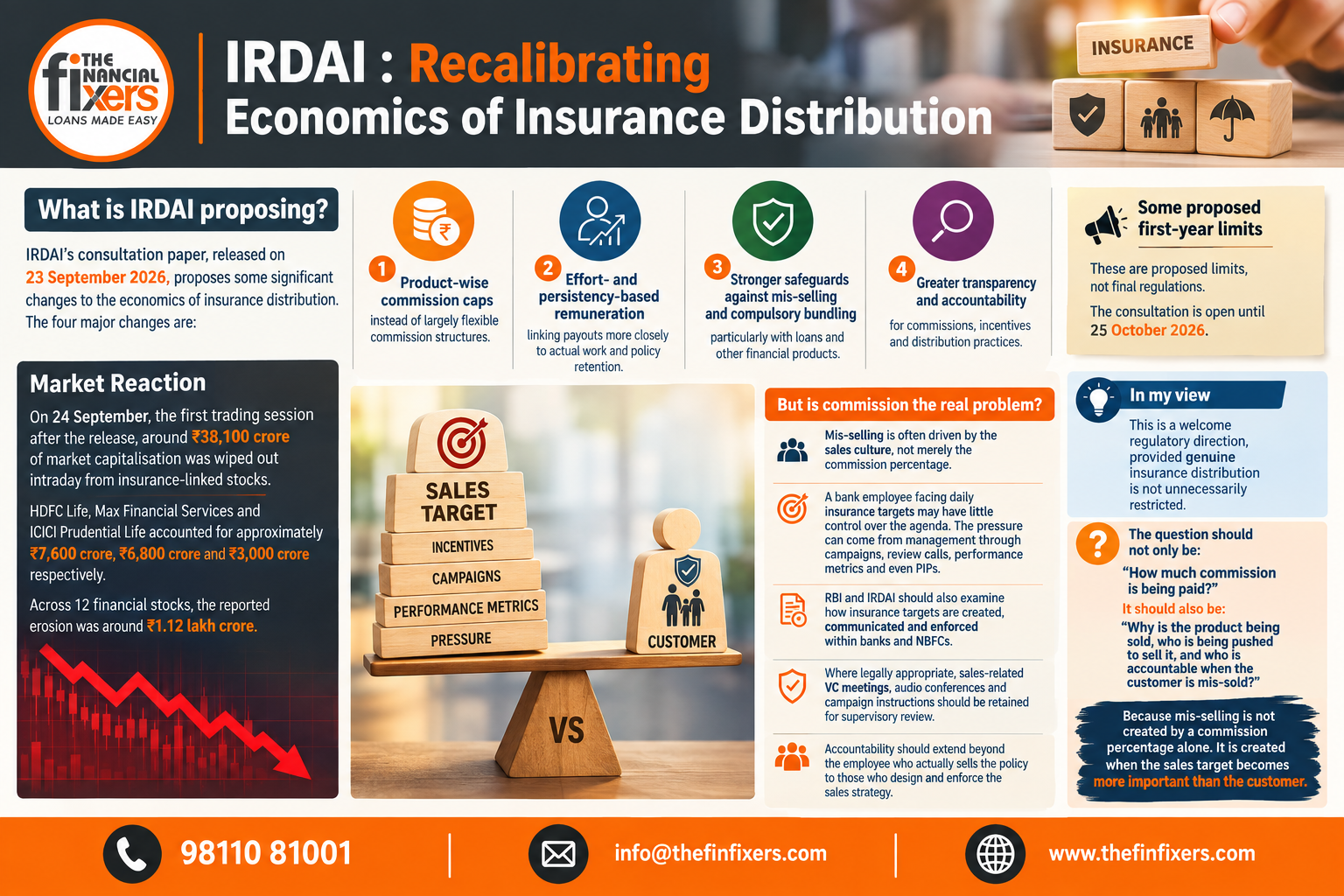
What is IRDAI proposing?
IRDAI’s consultation paper, released on 23 September 2026, proposes some significant changes to the economics of insurance distribution. The four major changes are:
- Product-wise commission caps instead of largely flexible commission structures.
- Effort- and persistency-based remuneration, linking payouts more closely to actual work and policy retention.
- Stronger safeguards against mis-selling and compulsory bundling, particularly with loans and other financial products.
- Greater transparency and accountability for commissions, incentives and distribution practices.
5. Some proposed first-year limits include:
| Product | Agent / IDP | Distribution Entity / IDE |
| Life – 10 years or more | 25% | 20% |
| Life – up to 5 years | 6.25% | 5% |
| Individual Health – New | 20% | 15% |
| Individual Health – Renewal | 10% | 5% |
| Motor – Own Damage | 10% | 5% |
| Motor – Mandatory TP | 2.50% | Nil |
IRDAI’s consultation paper “Recalibrating Economics of Insurance Distribution”, released on 23 September 2026, has triggered a sharp market reaction.
On 24 September, the first trading session after its release, around ₹38,100 crore of market capitalisation was wiped out intraday from insurance-linked stocks. HDFC Life, Max Financial Services and ICICI Prudential Life accounted for approximately ₹7,600 crore, ₹6,800 crore and ₹3,000 crore respectively. Across 12 financial stocks, the reported erosion was around ₹1.12 lakh crore.
These are proposed limits, not final regulations. The consultation is open until 25 October 2026.
But is commission the real problem?
Mis-selling is often driven by the sales culture, not merely the commission percentage.
A bank employee facing daily insurance targets may have little control over the agenda. The pressure can come from management through campaigns, review calls, performance metrics and even PIPs.
Therefore, RBI and IRDAI should also examine how insurance targets are created, communicated and enforced within banks and NBFCs.
Where legally appropriate, sales-related VC meetings, audio conferences and campaign instructions should be retained for supervisory review. Accountability should extend beyond the employee who actually sells the policy to those who design and enforce the sales strategy.
In my view
This is a welcome regulatory direction, provided genuine insurance distribution is not unnecessarily restricted.
The question should not only be: “How much commission is being paid?”
It should also be:
“Why is the product being sold, who is being pushed to sell it, and who is accountable when the customer is mis-sold?”
Because mis-selling is not created by a commission percentage alone. It is created when the sales target becomes more important than the customer.