India Mutual Funds
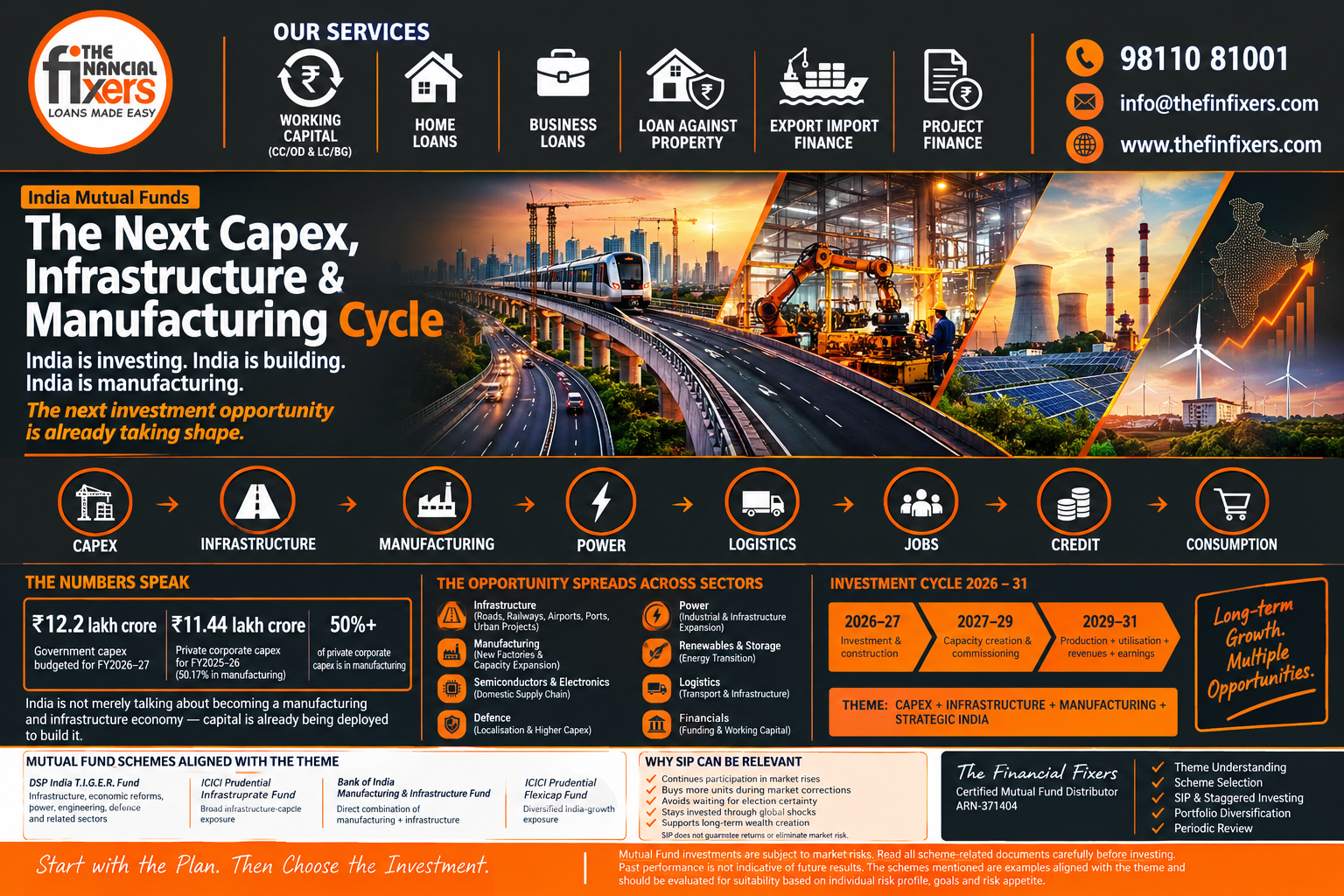
The Next Capex, Infrastructure & Manufacturing Cycle
India is investing. India is building. India is manufacturing. The next investment opportunity is already taking shape.
India’s growth story is entering a new phase.
₹12.2 lakh crore of government capital expenditure has been budgeted for FY2026–27. Private companies are committing trillions of rupees to new factories, energy projects, infrastructure and technology. Manufacturing now accounts for over 50% of reported private corporate capex.
This is no longer just an expected trend.
The investment cycle is already visible in the numbers.
And when a large economy simultaneously builds factories, roads, airports, power plants, defence systems, semiconductor facilities, data centres and logistics networks, the opportunity extends far beyond the companies directly executing these projects.
It creates an entire investment ecosystem:
CAPEX → INFRASTRUCTURE → MANUFACTURING → POWER → LOGISTICS → JOBS → CREDIT → CONSUMPTION
For mutual fund investors, this creates an opportunity to participate in multiple sectors benefiting from the same underlying economic cycle.
The numbers behind the theme
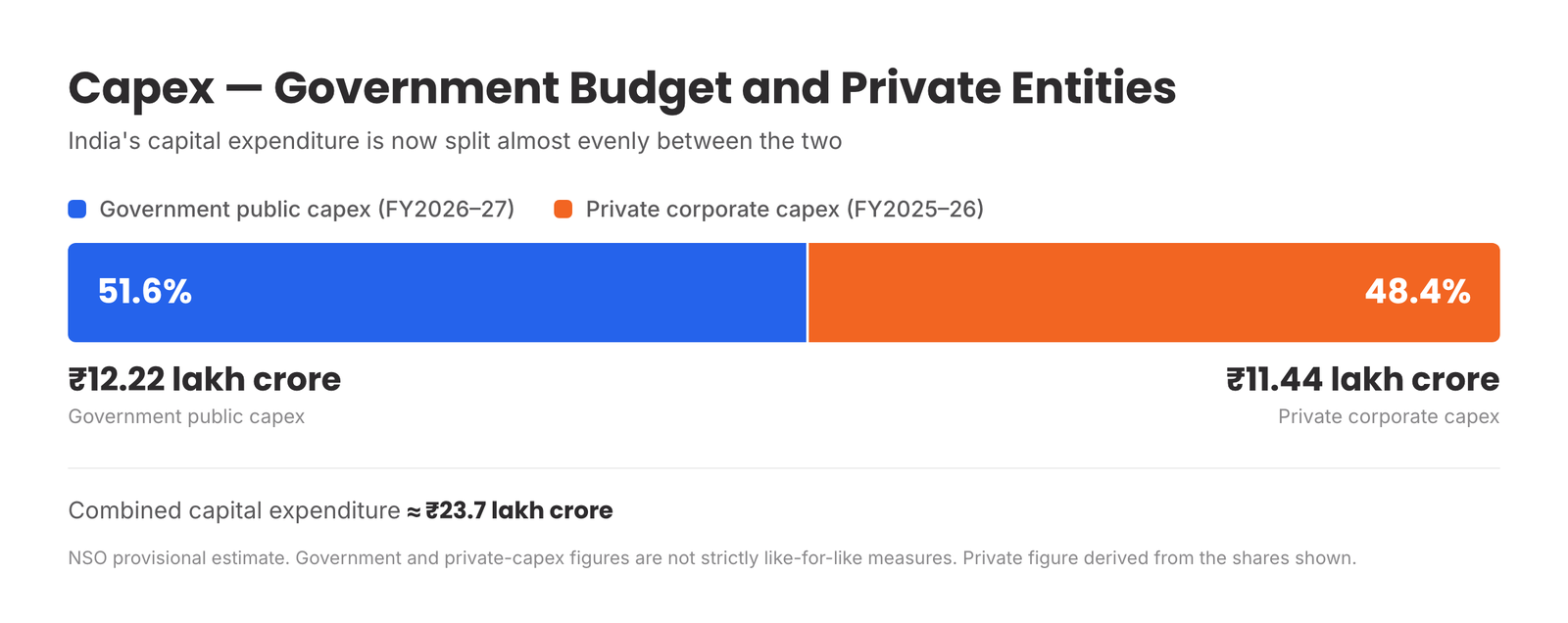
Capex – Government Budget and Private Entities
Private Sector Capex
NSO provisional estimate. Government and private-capex figures are not strictly like-for-like measures.
The scale tells an important story:
India is not merely talking about becoming a manufacturing and infrastructure economy but capital is already being deployed to build it.
India’s Capex Trajectory
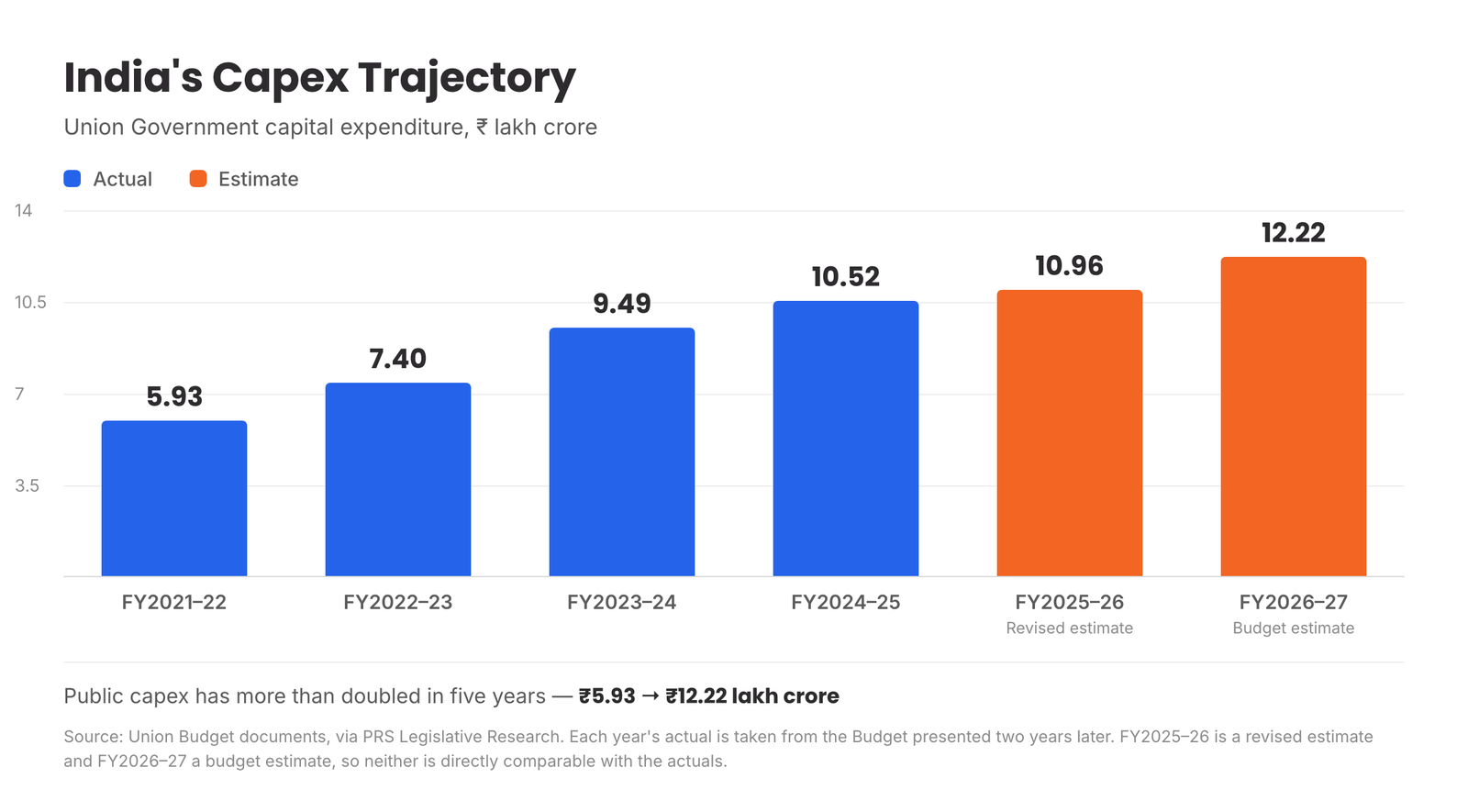
India's public-capex trajectory shows how dramatically the investment cycle has expanded over the last decade.
Why this theme matters for Mutual Fund Investors
The opportunity is spread across several sectors:
Infrastructure — Roads, railways, airports, ports, urban projects
Manufacturing — New factories & capacity expansion
Semiconductors & Electronics — Domestic supply-chain development
Defence — Higher capital allocation & localisation
Power — Industrial & infrastructure expansion
Renewables & Storage — Energy transition & rising electricity demand
Logistics — Manufacturing & infrastructure expansion
Financials — Funding of capex and working capital
This is why the theme is bigger than “Infrastructure”.
It is a Capex + Infrastructure + Manufacturing + Strategic India theme.
Private-sector participation is the key development
Government capex can create the initial demand.
But the real multiplier comes when private companies start investing alongside the Government.
The latest NSO survey estimated ₹11.44 lakh crore of private corporate capex for FY2025–26, with manufacturing contributing 50.17% of reported expenditure.
That is significant because private investment creates productive capacity that can generate revenues for many years.
Examples of actual corporate investment
These investments create demand across an extensive network of suppliers, contractors, equipment manufacturers, financial institutions and service providers.
The 2026–31 opportunity
The most interesting aspect of a capex cycle is that investment happens first; earnings follow later.
A simplified cycle looks like this:
2026–27
Investment & construction
↓
2027–29
Capacity creation & commissioning
↓
2029–31
Production + utilisation + revenues + earnings
Therefore, the 2026–31 period can be viewed as a potential earnings phase of investments being made today.
The investment case does not depend on predicting the outcome of the 2029 election.
It depends on whether today's investments translate into higher production, capacity utilisation, corporate earnings and economic activity.
Mutual Fund Schemes aligned with the theme
DSP India T.I.G.E.R. Fund — Infrastructure, economic reforms, power, engineering, defence and related sectors
ICICI Prudential Infrastructure Fund — Broad infrastructure-cycle exposure
Bank of India Manufacturing & Infrastructure Fund — Direct combination of manufacturing + infrastructure
ICICI Prudential Flexicap Fund — Diversified alternative for investors wanting broader India-growth exposure
DSP India T.I.G.E.R. Fund
The fund is not restricted to construction companies.
Its portfolio has included Reliance Industries, NTPC, Larsen & Toubro, Bharat Electronics and Hindustan Aeronautics, providing exposure to different parts of India's infrastructure and economic-development ecosystem.
DSP indicates an ideal holding period of 10 years or more, which is consistent with the long-term nature of a capex cycle.
Why SIP can be relevant
A strong theme can still experience sharp corrections.
SIP allows investors to participate through different market conditions rather than attempting to identify the perfect entry point.
Market rises → Continues participation
Market corrects → Buys additional units at lower prices
Election volatility → Avoids waiting for certainty
Geopolitical shock → Continues staggered investment
Long-term recovery → Remains invested
SIP does not guarantee returns or eliminate market risk.
Its primary benefit is discipline and reduced dependence on market timing.
What could change the investment thesis?
The theme should be tracked through data, not headlines.
Private capex → Sustained increase
Capacity utilisation → Rising
Industrial credit → Growing
Power demand → Sustained growth
Order books → Strong conversion into revenue
Corporate earnings → Capex translating into profits
Key risks
Valuation risk, High commodity prices, Global slowdown, Interest rates, Project delays and Weak private capex
The Financial Fixers – What makes the difference
Understanding an investment theme is just the beginning. The Financial Fixers, through its Certified Mutual Fund Distributor: ARN-371404, can help you turn that understanding into a structured and disciplined investment plan.
We help investors with:
· Theme Understanding
· Scheme Selection
· SIP & Staggered Investing
· Portfolio Diversification
· Periodic Review
Start with the Plan. Then Choose the Investment.
Whether you are starting your first SIP or exploring India's long-term growth themes, The Financial Fixers can help make your Mutual Fund investment journey more structured, informed and goal-oriented.
The Financial Fixers
Certified Mutual Fund Distributor
ARN-371404
Disclaimer:
Mutual Fund investments are subject to market risks. Read all scheme-related documents carefully before investing.
Mutual fund investments are subject to market risks. Read all scheme-related documents carefully before investing. Past performance is not indicative of future results. The schemes mentioned are examples aligned with the theme and should be evaluated for suitability based on individual risk profile, goals and risk appetite.